
Greece Yacht Charter
Crewed yachts from Athens, Corfu and Rhodes, from €12,000 a week plus VAT of 13% or less. Broker-led since 1992.
Reviewed by Adrian Sneed, Charter Broker at Sneed Charters — a family brokerage arranging Mediterranean charters since 1992. Greek rates, VAT and cruising fees checked September 2026.
IN SHORT
A crewed week in Greece starts around €15,000 for a catamaran in July and August, and nearer €12,000 in the shoulder months. Add an APA of 25–35% (an advance for fuel, food and berthing; whatever is unspent comes back to you) and VAT of 13%. The meltemi decides where you should be: the Cyclades in June or September, the Ionian and Saronic all season.
Choosing your island group
Five grounds, and the honest version of what each one asks of you. Best months are our recommendation, not an industry standard.
Cyclades
- Best months
- June, September
- Summer wind
- Strong in July and August (force 7–8)
- Between islands
- Longer, open-water crossings
- Start from
- Mykonos, Paros, Lavrio
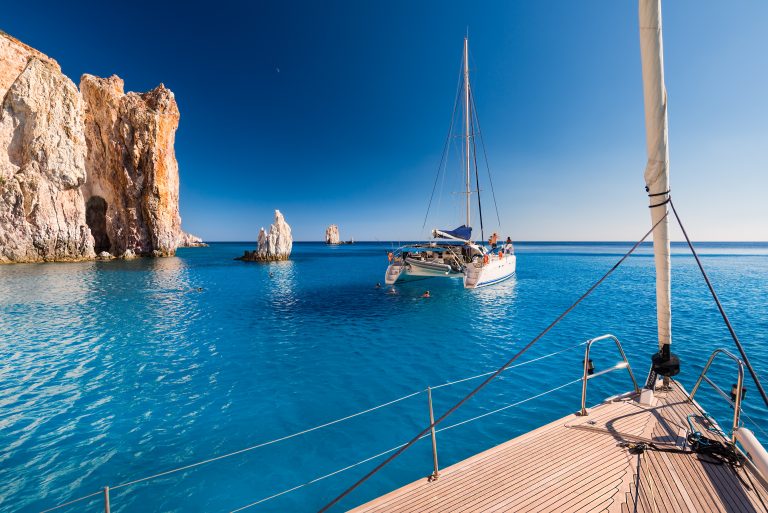
The classic Greek itinerary, and the windiest. Book it for June or September, or for a party that likes to sail. See a sample week.
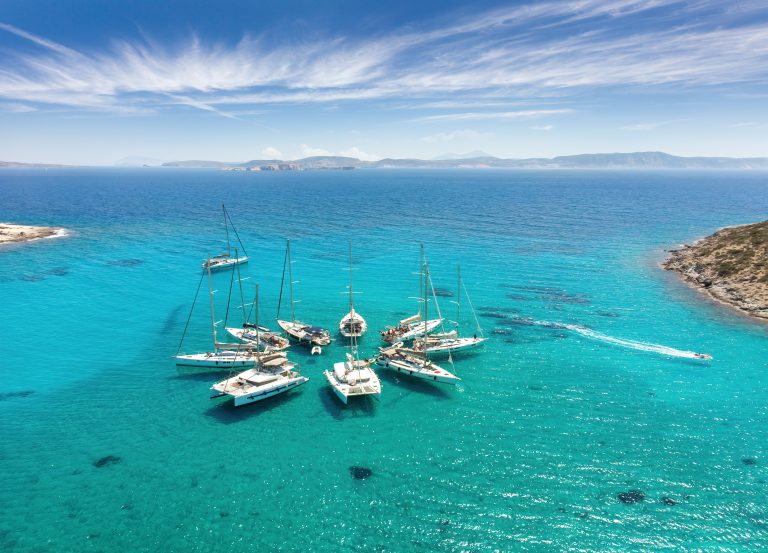
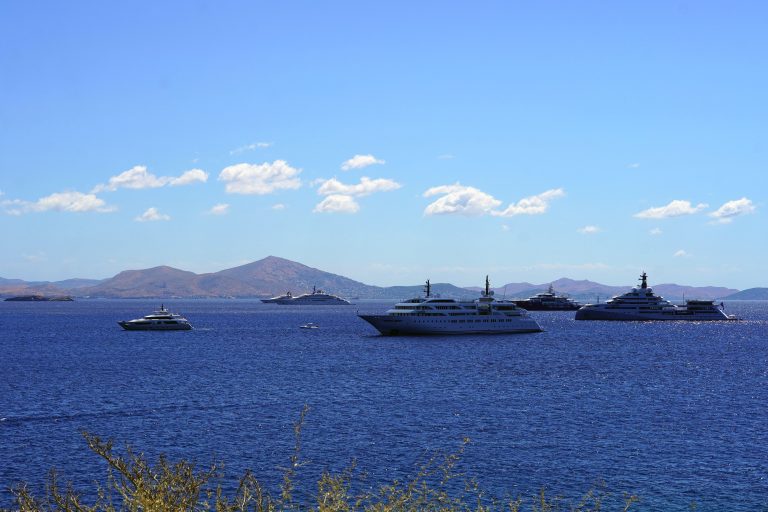
Pictured: yachts at anchor off Polyaigos, near Milos
Ionian
- Best months
- May to October
- Summer wind
- Light (force 3–5)
- Between islands
- Short hops
- Start from
- Corfu, Lefkada
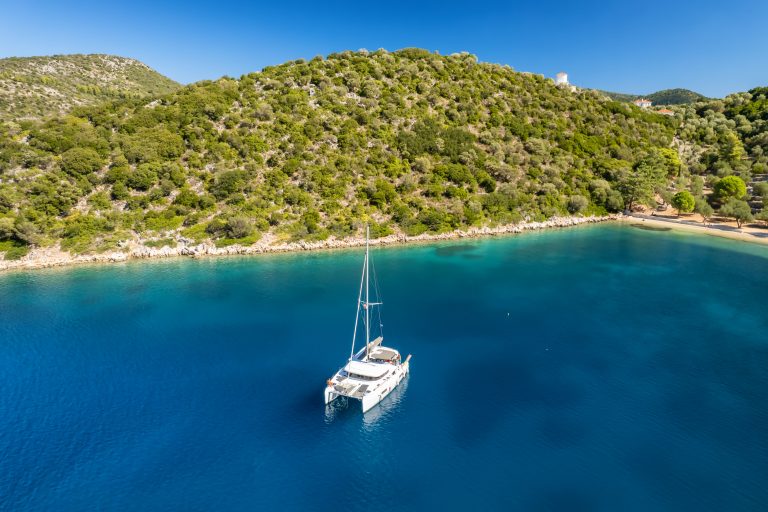
Outside the meltemi altogether, so a bad afternoon costs you an hour, not a day. With the Saronic, our pick for families, first charters and non-sailors. See a sample week.
Pictured: a catamaran moored near Dexia beach, Ithaca
Saronic
- Best months
- May to October
- Summer wind
- Moderate, softer than the Cyclades
- Between islands
- Short hops
- Start from
- Athens (Alimos)
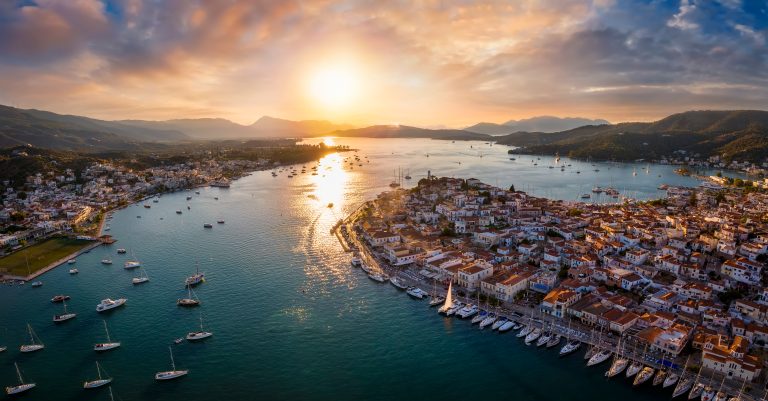
Aegina, Poros, Hydra and Spetses, all within a morning of Athens: a week without a domestic flight. The ground we put most first charters on. See a sample week.
Pictured: Poros town and harbour at sunset
Dodecanese
- Best months
- May to October
- Summer wind
- Fresh (force 5–6), calmer near the Turkish coast
- Between islands
- Medium hops
- Start from
- Rhodes, Kos
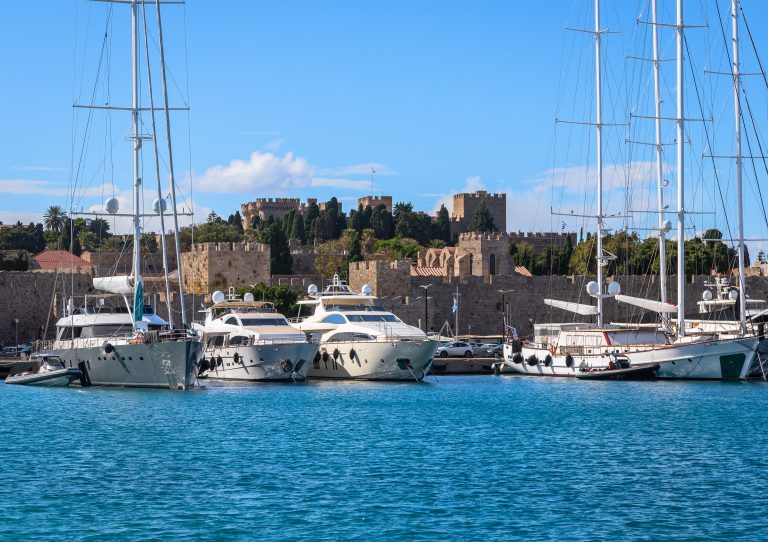
Quieter bays and fewer crowds, but not the calm option it is often sold as: the shelter is close to the Turkish coast, not across the island group as a whole. See a sample week.
Pictured: Mandraki Harbour, Rhodes
Sporades
- Best months
- June to September
- Summer wind
- Varies by island; your broker will advise
- Between islands
- Short hops
- Start from
- Skiathos, Volos
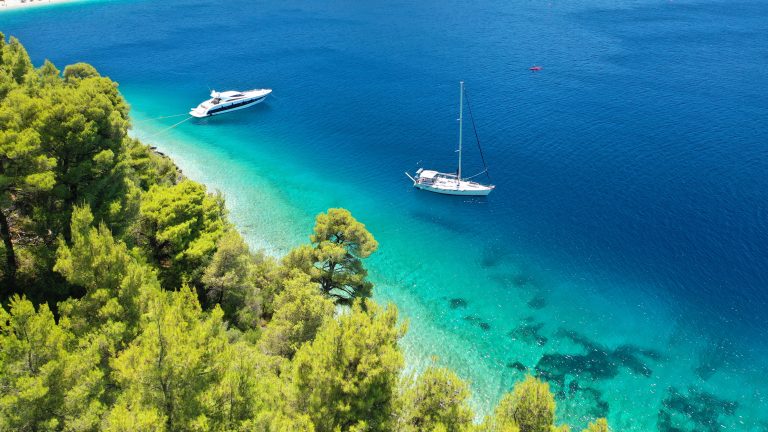
Green islands and the National Marine Park of Alonnisos. The one Greek week shaped by something other than wind and berths. See a sample week.
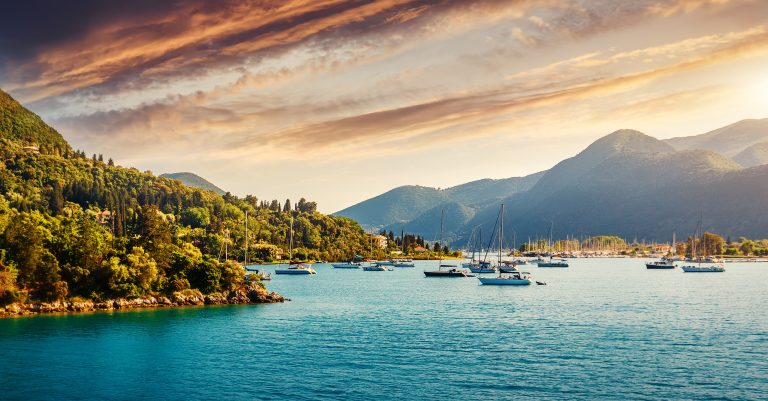
Pictured: a yacht anchored at Panormos, Skopelos
A sample week in each island group
Seven days in each of the five groups, all round trips, so none carries a one-way delivery fee. Pick a group; your captain sets the final route on the forecast.
A crewed week runs at your pace. Most days start with breakfast at anchor and a swim off the back of the yacht, then a short passage while you read on deck, lunch aboard or at a taverna ashore, and a new harbour or bay by late afternoon. The captain handles the sea, the chef cooks to the preferences you send before you fly, and the crew runs the tender and the water toys.
7-day Cyclades itinerary: round trip from Lavrio
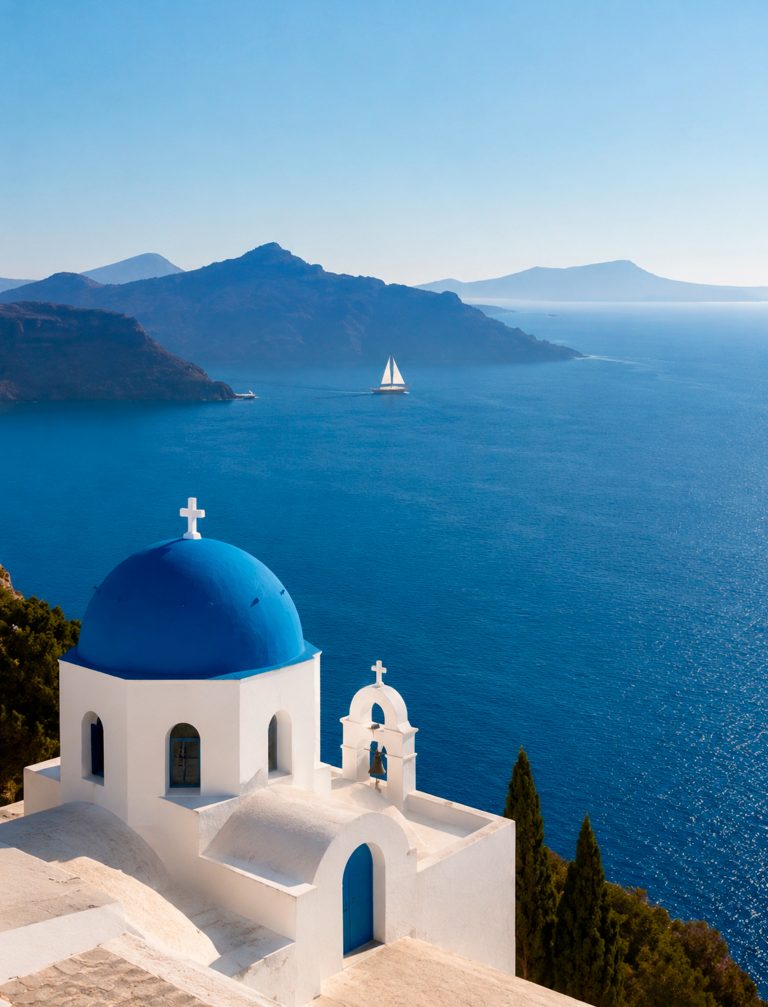
The northern and central Cyclades, with two longer open-water legs. Best in June or September.
- Day 1
Lavrio to Kea
Board at Lavrio on the Attica coast and cross to Kea, the closest of the Cyclades to the mainland, for a first swim and dinner aboard.
- Day 2
Kea to Syros
East across open water to Syros, started early while the wind is lightest. Ermoupoli is the capital of the Cyclades: neoclassical squares and a working town rather than a resort.
- Day 3
Syros to Mykonos
On to Mykonos. Walk Mykonos Town late in the afternoon, when the light is off the water: Little Venice, and the windmills on the ridge above it. Dinner aboard, or ashore if the crew has booked it.
- Day 4
Mykonos to Delos and Rineia
A short run to Delos for a guided morning on the archaeological site. In the afternoon, anchor off Rineia, uninhabited and just west of Delos; its bay at Skinos is one of the anchorages that holds in a meltemi.
- Day 5
Rineia to Paros
South to Paros and the Venetian harbour at Naoussa. Ashore, the choice is the inland villages, the marble quarries at Marathi or a beach day, with dinner in Naoussa afterwards.
- Day 6
Paros to Kythnos
The long leg of the week, west across open water to Kythnos, started at dawn. The anchorage at Kolona, a sandbar joining Kythnos to a small islet, is the place to spend the last night.
- Day 7
Kythnos to Lavrio
A morning run back across to Lavrio, and ashore by midday for the drive to Athens.
7-day Ionian itinerary: round trip from Lefkada
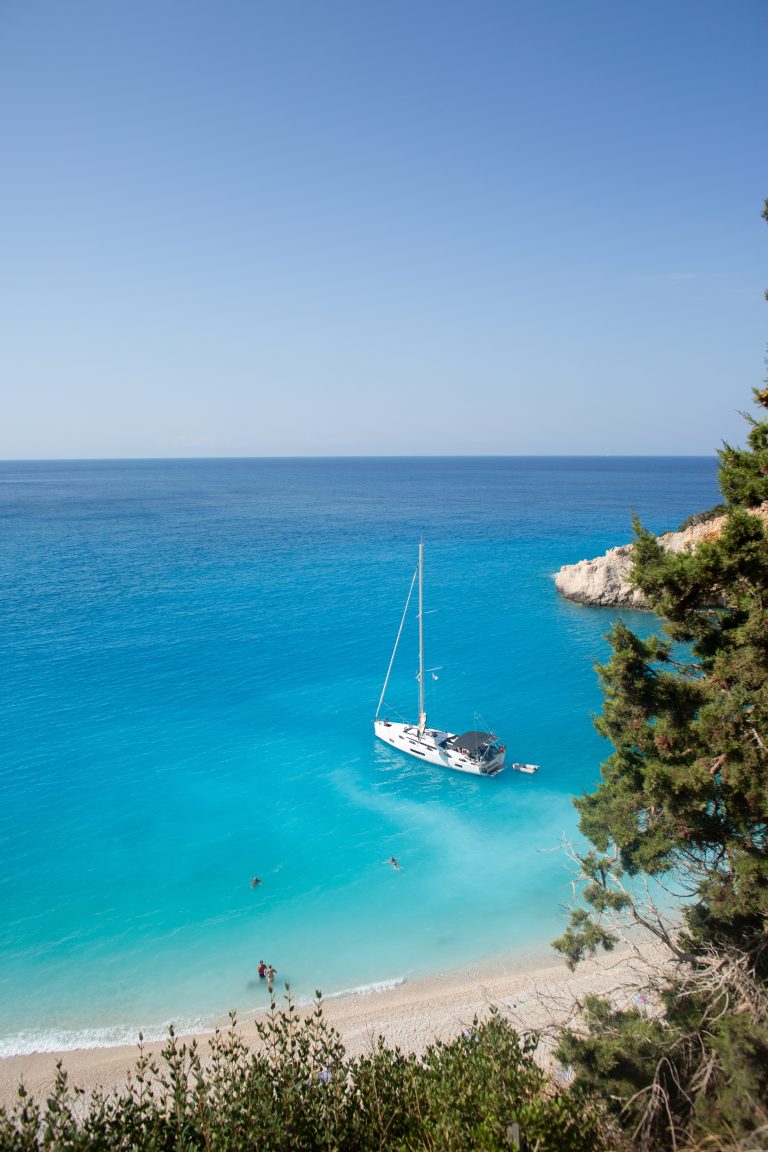
The southern Ionian, outside the meltemi, with every leg a few hours or less. With the Saronic, our pick for families and first charters, in any month.
- Day 1
Lefkada to Nidri
Board at Lefkada and run south through the canal to Nidri, on Lefkada’s sheltered east coast, for a first swim and a night at anchor.
- Day 2
Nidri to Meganisi
A short hop to Meganisi, the small island off Lefkada’s south-east corner, and the deep, indented bays around Vathi and Abelike.
- Day 3
Meganisi to Ithaca
South to Ithaca, with a swim at Dexia bay before Vathi, the harbour town at the head of a long, sheltered inlet.
- Day 4
Ithaca to Fiskardo
Round the north of Ithaca to Fiskardo, on Kefalonia’s northern tip. It came through the 1953 earthquake largely intact, so its Venetian-era houses still stand.
- Day 5
Fiskardo to Sivota
North across the channel to Sivota, a narrow inlet on Lefkada’s south coast with tavernas along the quay.
- Day 6
Sivota to Kalamos
East to Kalamos, a wooded island off the mainland with a small harbour and few visitors.
- Day 7
Kalamos to Lefkada
Back up Lefkada’s east coast and through the canal to the marina.
7-day Saronic itinerary: round trip from Athens
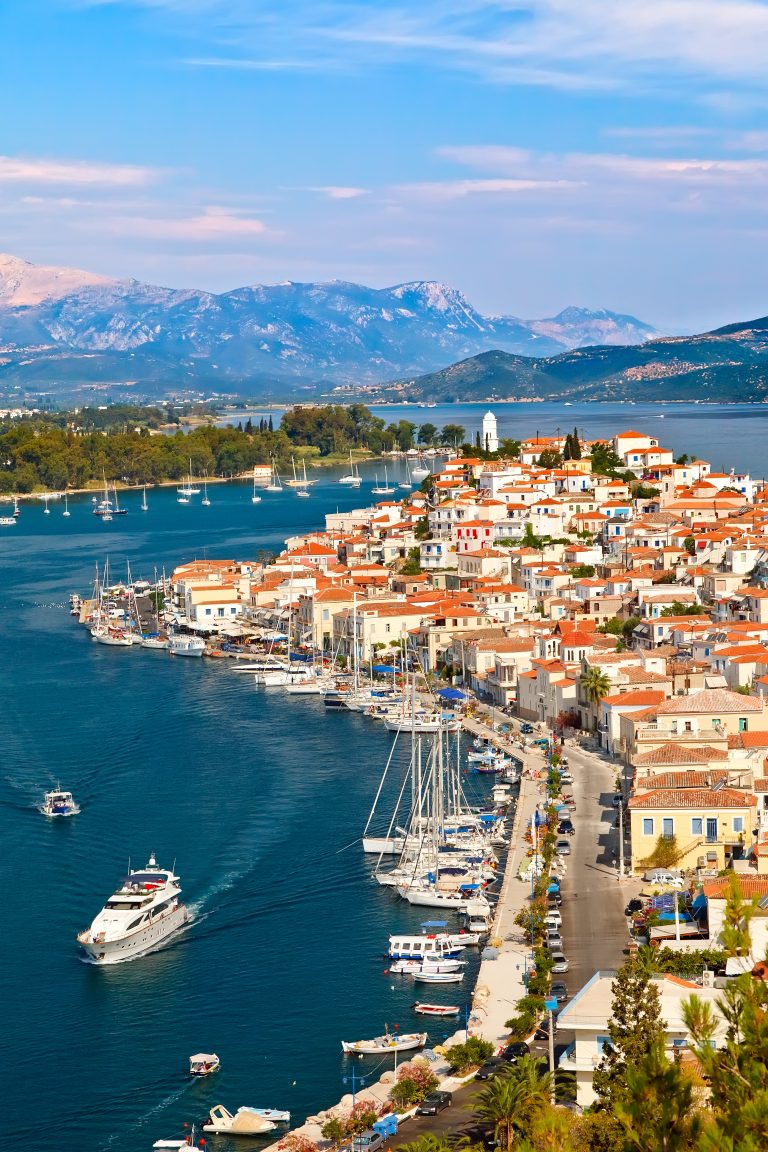
Five islands within a morning of Athens, and no domestic flight. The meltemi reaches the Saronic, but softer and less often than in the Cyclades.
- Day 1
Athens to Aegina
Board at Alimos and cross to Aegina. Moor off Perdika, the fishing village on the island’s south-west tip, for dinner ashore.
- Day 2
Aegina to Poros
South past the Methana peninsula to Poros, whose town faces the Peloponnese across a channel only a few hundred metres wide.
- Day 3
Poros to Hydra
To Hydra, where cars are not allowed and the harbour is ringed by stone mansions. Berths are tight in summer, so the plan is to arrive early or anchor round the coast.
- Day 4
Hydra to Spetses
West to Spetses, the pine-covered island at the mouth of the Argolic Gulf, with an old harbour and an evening walk into town.
- Day 5
Spetses to Dokos
Back east to Dokos, an almost uninhabited island off Hydra, and a quiet night at anchor in Skintos bay.
- Day 6
Dokos to Agistri
The longest leg of the week, north to Agistri, Aegina’s small pine-covered neighbour, and the clear water of Dragonera bay.
- Day 7
Agistri to Athens
Back across the Saronic Gulf to Alimos, and ashore by midday.
7-day Dodecanese itinerary: round trip from Rhodes
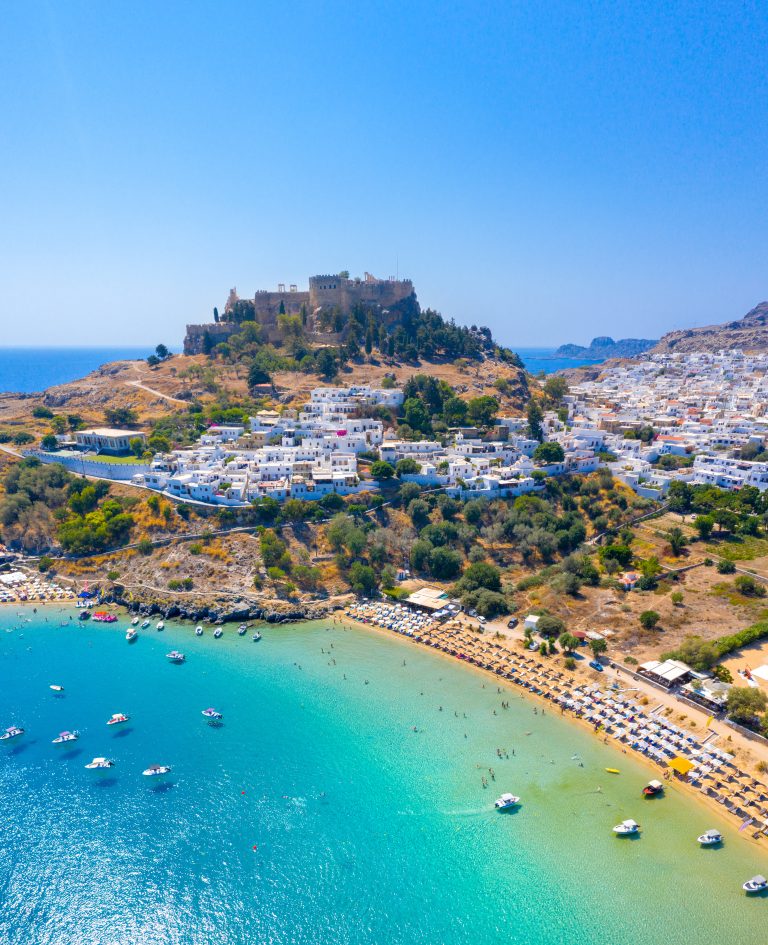
Quieter islands to the west of Rhodes, then the east coast home. One long leg, round the south of Rhodes, which the captain takes only in settled weather.
- Day 1
Rhodes to Symi
Board at Mandraki harbour and cross to Symi, whose harbour at Gialos is lined with neoclassical houses in ochre and pastel.
- Day 2
Symi to Panormitis
Round to Panormitis on Symi’s south coast, a sheltered bay below the island’s large monastery.
- Day 3
Panormitis to Tilos
West to Tilos, one of the quietest islands in the Dodecanese, and the harbour at Livadia.
- Day 4
Tilos to Chalki
South to Chalki, a small island whose one village, Emborio, wraps around the harbour.
- Day 5
Chalki to Lindos
The long leg, round the south of Rhodes to Lindos and St Paul’s Bay below the acropolis. In a fresh northerly the captain may run back up the west coast instead.
- Day 6
Lindos to Anthony Quinn Bay
North up the east coast, in the lee of the island, to Anthony Quinn Bay, a narrow cove of very clear water near Faliraki.
- Day 7
Anthony Quinn Bay to Rhodes
A short run back to Mandraki, with time for the medieval Old Town before you step ashore.
7-day Sporades itinerary: round trip from Skiathos
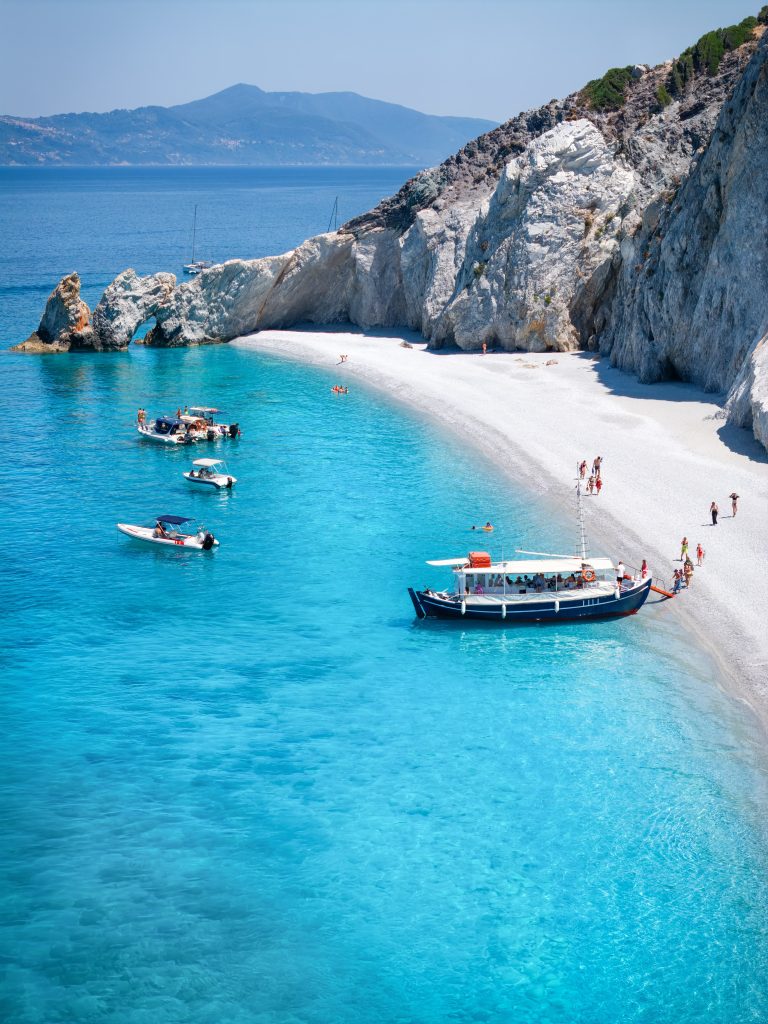
Green islands in the northern Aegean and a day inside the National Marine Park of Alonnisos. Short legs throughout.
- Day 1
Skiathos to Skopelos
Board at Skiathos and cross to Panormos bay on Skopelos’s west coast, where the pine trees come down to the water.
- Day 2
Panormos to Skopelos Town
Round to Skopelos Town, its white houses climbing the hillside above the harbour.
- Day 3
Skopelos to Alonnisos
East to Alonnisos and the small harbour of Steni Vala, on the edge of the marine park.
- Day 4
A day in the marine park
Into the National Marine Park of Alonnisos, the largest marine protected area in Europe, set up in 1992 for the Mediterranean monk seal. Anchor in the bays of Peristera, in the zone where yachts are allowed; the core zone is closed to every vessel.
- Day 5
Alonnisos to northern Skopelos
Back west to the north of Skopelos and the chapel of Agios Ioannis on its rock, the one from the film Mamma Mia!
- Day 6
Skopelos to Skiathos
Across to Skiathos’s north coast for Lalaria beach, reachable only by sea, then round to Koukounaries for the night.
- Day 7
Koukounaries to Skiathos Town
A short run back to Skiathos Town, and ashore by midday.
Want one of these weeks planned around your dates and the yacht you have in mind?
Your broker builds the route around your party, the yacht and the forecast for that week.
Plan my weekWhen to go
September is the month to want. The sea is still as warm as in July, the meltemi has eased, and the crowds have gone home — 41.6% of all Greek tourist nights fall in July and August alone. It is also, for the same reasons, the month the good yachts go first.
Best months for each island group
Our recommendation for each Greek ground, laid across the season.
months we recommend for that ground July and August, the peak weeks, where we do not
| Month | Aegean air | Aegean sea | Season | Meltemi |
|---|---|---|---|---|
| May | 19.5°C | 18.5°C | Shoulder | Beginning |
| June | 23.7°C | 21.5°C | Shoulder | Building |
| July | 25.7°C | 23.5°C | Peak | Peak from mid-month |
| August | 25.8°C | 24.0°C | Peak | Peak to mid-month |
| September | 23.2°C | 23.5°C | Shoulder | Easing |
| October | 19.8°C | 21.9°C | Shoulder | Gone |
Aegean figures are Mykonos, on 1991–2020 normals.
Why the month matters: the meltemi
The meltemi is a northerly wind that blows across the Aegean from May to September and peaks between mid-July and mid-August. It regularly holds above 29 knots with gusts of 39 to 49, builds through the afternoon and can run for one to seven days without a break. It is forecastable, and it decides which islands make sense in which month.
It blows hardest in the Cyclades, and harder still through the straits: Euboea to Andros, Kea to Kythnos, Paros to Naxos. The Dodecanese is not the calm alternative it is often sold as; the shelter there is only in the lee of the Turkish coast. The Saronic gets a softer version, and the Ionian sits outside it altogether.
The same day, three Greek grounds. Hellenic National Meteorological Service forecast for 31 July 2026, on the Beaufort scale.
The red marker is the gust to force 9. That day, ferries to Syros, Tinos and Mykonos were cancelled while Saronic services ran normally. It happened again on 14 August, with cancellations to eleven Cycladic islands.
How we plan around it:
- July or August with guests who are not sailors: we book the Ionian or the Saronic. You lose the Mykonos photograph. You keep the week.
- In the Cyclades, the forecast sets the route. The loop runs clockwise or anticlockwise to suit the wind, and long legs start at dawn, before the afternoon build.
- Alongside by 14:00, at anchor where it holds. Berths run out when the wind is up; off Mykonos, Elia and Skinos on Rineia hold in a northerly where Ornos does not.
The full explainer is in our guide to the meltemi.
What a crewed week in Greece costs
A crewed catamaran starts around €12,000 a week in the shoulder months and €15,000 in July and August. The four yacht types are below. On top of the rate come three things: an APA, VAT and a crew tip, shown line by line further down.
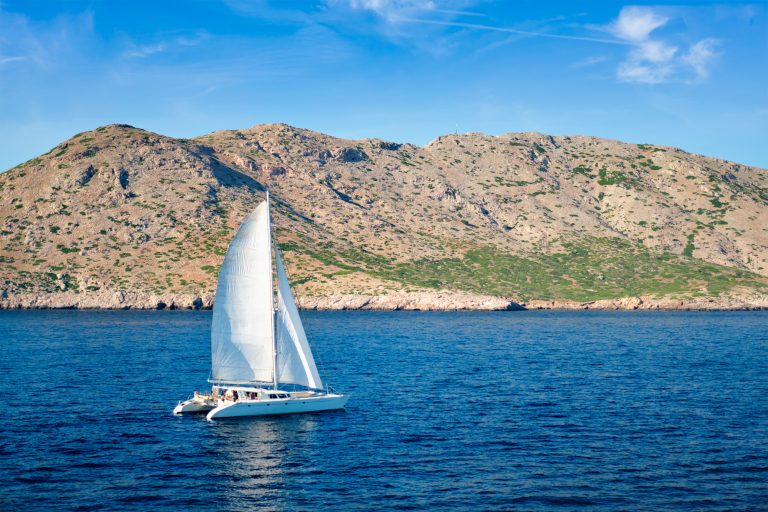
Crewed sailing catamaran
- Size
- 50–55 ft
- Shoulder
- from €12,000
- July–August
- from €15,000
- Guests
- 8–10
Stable at anchor and roomy on deck: the usual choice for a first charter.
Pictured: a catamaran in the Aegean
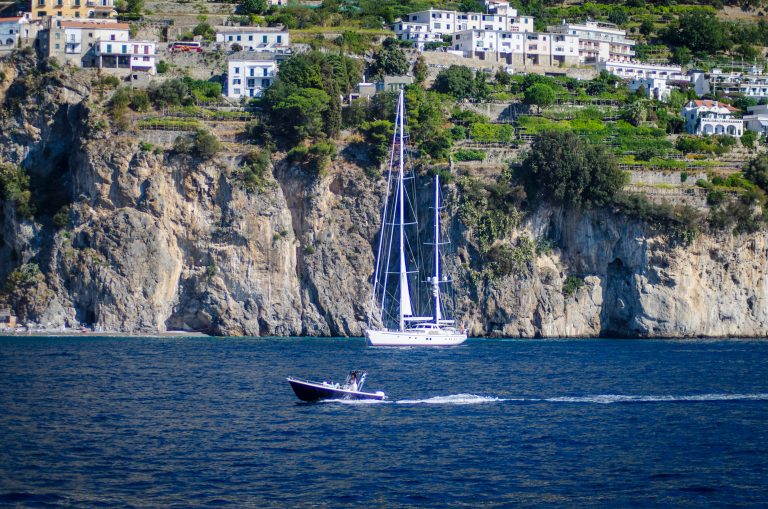
Crewed sailing yacht
- Size
- 50–70 ft
- Shoulder
- €12,000–€22,000
- July–August
- €20,000–€38,000
- Guests
- 6–8
For a party that wants to sail, at its best in the Cyclades in June or September.
Pictured: a sailing yacht in the Mediterranean
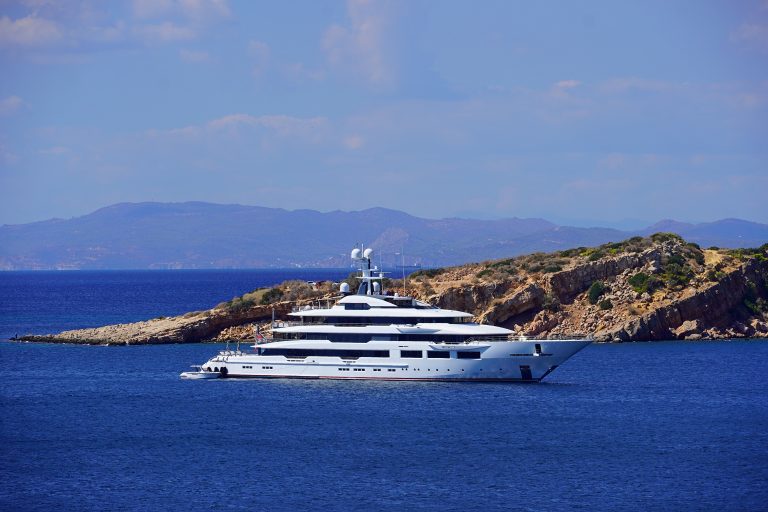
Crewed motor yacht
- Size
- 70–90 ft
- Shoulder
- €18,000–€35,000
- July–August
- €30,000–€55,000
- Guests
- 8–10
Range and comfort: covers more water in a day, so a long crossing takes a morning rather than the day.
Pictured: a motor yacht off Vouliagmeni, Athens
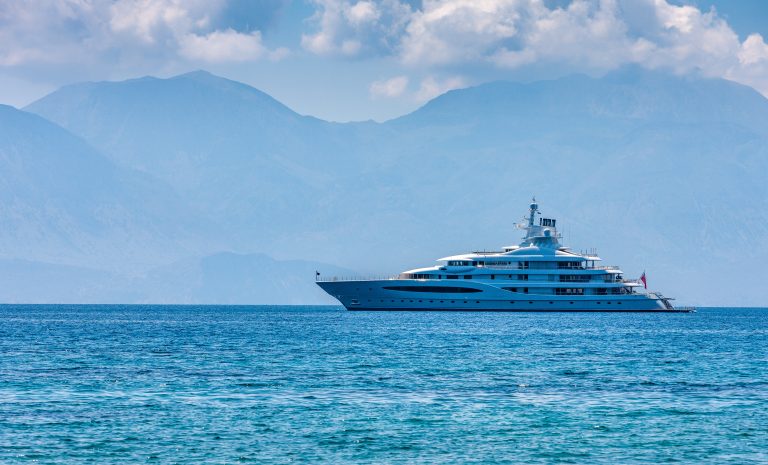
Superyacht
- Size
- 100 ft and above
- Shoulder
- €40,000–€80,000
- July–August
- €60,000–€200,000+
- Guests
- 10–12
Full service, the most space aboard and the largest crew. Over 35 metres, ask early about the yacht’s Greek permit days.
Pictured: a large yacht off Crete
Shoulder is May, June, September and October. Peak is July and August. To see individual yachts, search our fleet.
Those are market ranges, not a menu. What you actually pay turns on the yacht, the week and how early you ask — and the same catamaran that lists at €15,000 in August is frequently €12,000 in late September, with the sea still warm and the meltemi easing.
Greek VAT on a crewed week is 13%, level with Croatia and below France, Spain and Italy, and many yachts invoice it lower still, at 5.2–12%. We tell you which rate applies before you sign. The full comparison is on our Mediterranean charter page.
What a week actually costs, all in
A €60,000 charter fee is not what leaves your account. Add an APA of 25–35% and 13% VAT on the fee, and the realistic total is €82,800 to €88,800, roughly 38 to 48% above the headline. A crew gratuity of 10–15% is customary and sits on top.
| Line | Low case | High case |
|---|---|---|
| Charter fee | €60,000 | €60,000 |
| APA at 25–35% | €15,000 | €21,000 |
| Greek charter VAT at 13% | €7,800 | €7,800 |
| All in | €82,800 | €88,800 |
On a yacht invoiced at a reduced 6.5%, take €3,900 off both totals. A one-way week or a yacht repositioned for you adds a delivery fee, which we quote before you sign. The APA is a float, not a fee: whatever is unspent comes back to you. See our full guide to yacht charter costs.
What is included, and what is not
On MYBA terms, the weekly rate covers the yacht and crew, running costs come out of the APA, and a few items sit outside both.
In the charter fee 4 items
- Yacht and full crew: captain, chef, deck, interior
- Insurance and running maintenance
- Water toys and tenders aboard
- Menus planned around your tastes and allergies
Paid from the APA 4 items
- Fuel for the yacht and tenders
- All food and drink
- Berths, moorings and port fees
- Communications, laundry, deliveries
In the Cyclades in August, berths are the real constraint.
Outside both 5 items
- Greek VAT: 13%, often lower on the invoice
- Crew gratuity, 10–15%, your choice
- Delivery fees, if the yacht repositions
- TEPAI cruising tax, where passed on
- Flights, hotels and travel insurance
Want this worked out for a real yacht and your dates?
Get My ShortlistYour broker replies within one business day with yachts that are actually free for your week, priced with APA and VAT included. No fee to you.
Your brokers
You get a named broker, not a call centre. The same person takes your first message, negotiates the contract and is reachable while you are aboard.

Hansel Sneed
Founder & Charter Broker
Hansel founded Sneed Charters in 1992 and has been placing crewed charters for more than thirty years.

Adrian Sneed
Charter Broker
Adrian is the broker who reviewed the rates, taxes and cruising fees published on this page, and the person who will answer when you send your dates.
Get a shortlist for your dates
Tell us the group, the dates and roughly what you want to spend. Your broker comes back with yachts that are actually free for your week.
- Reply within one business day
- Priced with APA and VAT included
- No fee to you
Prefer to talk it through? Call 1-561-463-6840 or message us on WhatsApp.
What happens after you send it
- Your broker checks which yachts are genuinely free for your week.
- You get a shortlist with landed costs: charter fee, APA estimate, VAT and any delivery fee.
- You choose. We negotiate and contract on MYBA terms, the industry-standard charter agreement: 50% on signing, the balance about a month before.
Greece yacht charter FAQs
How much does it cost to charter a yacht in Greece for a week?
A crewed catamaran starts around €15,000 a week in July and August and nearer €12,000 in the shoulder months. Crewed sailing yachts of 50 to 70 feet run €20,000 to €38,000 in peak season, motor yachts of 70 to 90 feet €30,000 to €55,000, and superyachts from €60,000. Add an APA of 25–35% and VAT of 13%.
When is the best time to charter a yacht in Greece?
September, for most people. The sea is as warm as in July, the meltemi has eased, and the crowds have gone — 41.6% of Greek tourist nights fall in July and August. June is the other shoulder month worth asking for. If you must travel in peak season, take the Ionian or the Saronic rather than the Cyclades.
What is the meltemi and will it affect my charter?
A northerly wind that blows across the Aegean from May to September, peaking between mid-July and mid-August, regularly above 29 knots with gusts to 49. It affects the Cyclades most and the Ionian not at all. It is forecastable, so it is planned around rather than gambled on.
How much VAT do I pay on a Greek yacht charter?
13% is the statutory rate for a commercial crewed charter of more than 48 hours; 24% applies to bareboat and static charters. In practice yachts certified under the Greek reduction regime are invoiced on a reduced taxable value, which puts the effective rate between 5.2% and 12% — 6.5% is common on crewed catamarans. We confirm which applies before you sign.
What is TEPAI?
A Greek cruising tax charged on every leisure vessel over 7 metres in Greek waters regardless of flag. Above 12 metres it is €8 per metre per calendar month, with a 25% reduction for vessels in exclusive professional use. The yacht administers it, not you.
Which Greek islands are best for a first charter?
The Ionian or the Saronic. Both sit outside the meltemi’s worst, both have hops short enough that weather costs you an hour rather than a day, and the Saronic starts from Athens with no domestic flight. Keep the Cyclades for a second week, once you know how your party likes to sail.
Where do Greek yacht charters start?
Most start in Athens, at Alimos, the largest marina in Greece, which puts the Saronic within a morning and the Cyclades within a day. Lavrio, an hour further round the coast, saves that day for the Cyclades. Corfu and Lefkada serve the Ionian, Rhodes and Kos the Dodecanese, and Skiathos the Sporades.
Can I charter a superyacht in Greece?
Yes, from about €60,000 a week in peak season. One constraint to know early: foreign-flagged commercial yachts over 35 metres charter in Greek waters under the e-Charter Permission regime, capped at 21 days a calendar year, which is why availability on the largest yachts tightens late in the season.
Do I pay a fee to use a charter broker?
No. The yacht’s owner pays our commission, and the charter rate is the same whether you book through us or direct. You get a named broker who sends a shortlist of yachts actually free for your dates, priced with APA and VAT, and who stays reachable while you are aboard.
SOURCES
- Tyrlis & Lelieveld, Journal of the Atmospheric Sciences — climatology and dynamics of the summer Etesian winds
- Hellenic National Meteorological Service — the climate of Greece
- Independent Authority for Public Revenue, Greece — e-TEPAI cruising tax
- National Marine Park of Alonnisos — protected zones and vessel access
- Eurostat — tourism seasonality, 2025 reference year
- MYBA, The Worldwide Yachting Association — the MYBA Charter Agreement
- Stephenson Harwood, e-Charter Permission: the digitalization of chartering in Greece (April 2024) — the 21-day cap and 7-day extension