

Superyacht Charter
Fully crewed yachts of 24 metres and above, in the Mediterranean, the Caribbean and beyond. Broker-led since 1992.
Reviewed by Adrian Sneed, Charter Broker at Sneed Charters — a family brokerage arranging crewed yacht charters since 1992.
A crewed superyacht week runs from roughly €250,000 to well past €500,000, before an APA of 25–35%, VAT at the rate of the country you board in, and a discretionary gratuity. Twelve guests is the ceiling on almost every charter yacht afloat, and it is a regulatory boundary rather than a comfort decision. The MYBA agreement everyone quotes is a contract of blanks: it fixes far less than brokers imply, which is exactly why it matters who fills the blanks in.
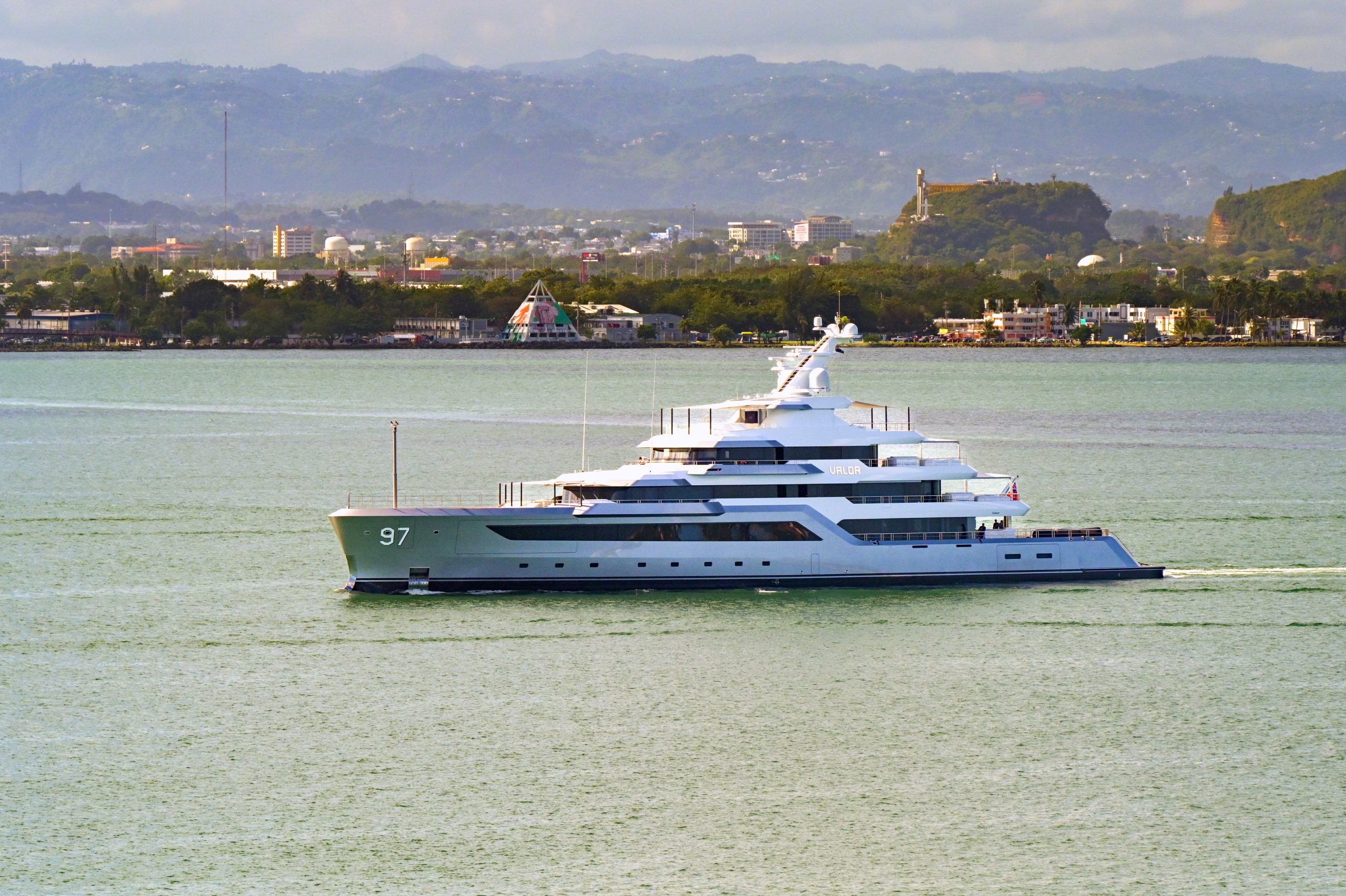
What actually counts as a superyacht
Nothing, legally. “Superyacht” and “megayacht” are marketing words with no regulatory definition. What does exist is a set of thresholds where the rules change, and they are worth knowing because they explain why yachts are the sizes they are.
24 metres is the real line. It comes from the International Convention on Load Lines of 1966, written for merchant ships, and flag states adopted it when they wrote their large-yacht codes. Above 24 metres in load line length, a commercial yacht carrying up to twelve passengers falls under the Red Ensign Group Yacht Code, Part A.
Note load line length, not overall length. Load line length is a formula — broadly 96% of the waterline length — so it is shorter than the figure in the brochure. The consequence is a real one: a yacht can be built to approach 30 metres overall while measuring under 24 metres for regulatory purposes, and stay outside the code. If you are comparing two yachts of similar advertised length, they may not be under the same rules at all.
500 gross tons is the bigger step. At and above 500 GT on international voyages, a commercial yacht is treated as a cargo ship under SOLAS and must apply the ISM and ISPS codes in full — a documented safety-management system, a ship security plan, and the certificates that go with them. Below that, most flags apply a scaled-down version. A strictly private yacht sits outside both regimes entirely, which is one of several reasons a private yacht offered to you for charter should give you pause.
One correction worth making, because it is still repeated: LY3, the Large Commercial Yacht Code, was superseded by the Red Ensign Group Yacht Code on 1 January 2019. The current edition is July 2024. A yacht described to you as “LY3 coded” is being described in language that has been out of date for seven years.
The twelve-guest rule, and why it is not a cap
Almost every charter yacht in the world sleeps twelve guests, and owners are not being modest. Under SOLAS Chapter I, a ship carrying more than twelve passengers is a passenger ship. Take a thirteenth guest aboard and the yacht is reclassified, and the full passenger-ship regime — subdivision, damage stability, escape routes, fire protection — applies to a vessel that was never built to meet it. Twelve is where yachts stop in order to stay on the right side of that line.
Crew are not passengers under the same definition, which is why a yacht limited to twelve guests can carry thirty or more people aboard without difficulty.
There is a route above twelve. Part B of the Red Ensign Group Yacht Code — the Passenger Yacht Code — covers yachts carrying more than twelve but not more than thirty-six passengers, with no more than 200 persons aboard in total, and it applies at any size. Those yachts exist and we can source them, but there are few of them and they price accordingly. If you have a party of sixteen, the honest answer is usually two yachts cruising together rather than one large one.
What the MYBA agreement actually says
Almost every superyacht charter is written on the MYBA Charter Agreement, and almost every description of it you will read is wrong in the same direction. The contract is far less prescriptive than the industry implies.
The agreement contains no fixed APA percentage — the advance provisioning allowance appears as a blank to be completed. It contains no fixed payment split — the instalments and their due dates are blanks. And it contains no gratuity clause at all. The 30% APA and the 10% tip you will be quoted as though they were contract terms are market conventions layered on top of a document that says nothing about either.
What the agreement does fix is the division of costs. The charter fee covers the yacht and her equipment in working order, stores and consumables, laundry of the ship’s linen, the crew’s wages, uniforms and food, and insurance of vessel and crew. The charterer separately pays for fuel for main engines, generators, tenders and water toys; all food and beverages for the charter party; and berthing, harbour charges, pilotage, local taxes, divers’ fees, customs formalities and waste disposal. Those are the APA items.
The APA is a float, not a fee. It is paid before you board, spent on your behalf, and accounted for at the end of the week against receipts, with the balance refunded. Where it goes wrong is fuel: a fast motor yacht driven hard will consume an APA that would have covered a sailing yacht comfortably for the same week.
The conventions, stated as conventions: APA is typically 25–35% of the charter fee on “plus expenses” terms, and materially lower on the rare all-inclusive contract. Gratuity is customarily 5–15%, occasionally more, entirely at your discretion, and owed under no clause of any agreement. Payment is usually 50% on signature with the balance plus VAT and APA about a month before boarding, and a refundable security deposit where the yacht requires one.
What a superyacht week costs
| Size | Indicative week | Typical crew | Notes |
|---|---|---|---|
| 24–30 m | €60,000–€150,000 | 2–8 | Entry to the coded fleet |
| 30–60 m | €150,000–€450,000 | 8–20 | The core charter market |
| 60 m and above | €450,000–€1m+ | 20–50+ | Berth availability becomes the constraint |
Crew numbers are from YPI Crew’s published bands. We have deliberately not published a crew-to-guest ratio: the figure gets quoted constantly and we could not find a source that stands behind it. Crew are organised in three departments — deck under the captain, engineering, and interior — and the mix varies more by yacht than by size.
VAT, and why the starting port sets it
Under Article 56 of the EU VAT Directive, the short-term hire of a means of transport is taxed where the vessel is put at the disposal of the customer — and for vessels, “short-term” means up to 90 days. That is the legal reason the country you board in sets the rate for the whole charter, however far you cruise afterwards.
| You board in | VAT on the charter fee | What changes it |
|---|---|---|
| Greece | 13% | 24% for a charter of 48 hours or less. Reduced effective rates are claimed for some certified yachts; we confirm per yacht rather than publish a figure we cannot stand behind. |
| Croatia | 13% | Charged pro rata for Croatian-water days where the charter starts outside the EU |
| France | 20% | Only the documented portion outside EU waters is relieved |
| Turkey | 20% | Raised from 18% in July 2023 |
| Spain, incl. Balearics | 21% | Spanish charter licence required |
| Italy | 22% | The lump-sum rate for yachts over 24 m was abolished in November 2020 |
| Caribbean — BVI, St Martin, Grenadines | None | Cruising permits and local fees apply instead |
Where a large yacht may legally work
Above 35 metres, Greece becomes a scheduling problem rather than a tax one. Foreign-flagged commercial yachts over 35 metres charter in Greek waters under the e-Charter Permission regime, introduced under Law 4926/2022 and applied for through the Ministry of Shipping’s electronic platform. It is capped at 21 charter days per calendar year, extendable by a further seven. A yacht requires a foreign commercial yacht inspection certificate, and a charter fee of at least €500 is payable.
That cap is the reason a particular large yacht may simply not be available to you in Greek waters late in the season — she has spent her days. It is worth establishing before you fall for a specific boat.
Separately, Greece charges TEPAI, a cruising tax on every leisure vessel over seven metres in its waters regardless of flag. Above twelve metres it is €8 per metre per month, counted from the first metre, with a 25% reduction for vessels in exclusive professional use and a 10% discount for paying the year in advance. A 50-metre yacht is €400 a month before the reduction. It is the yacht’s liability, not yours, but it is in the numbers somewhere.
When to go
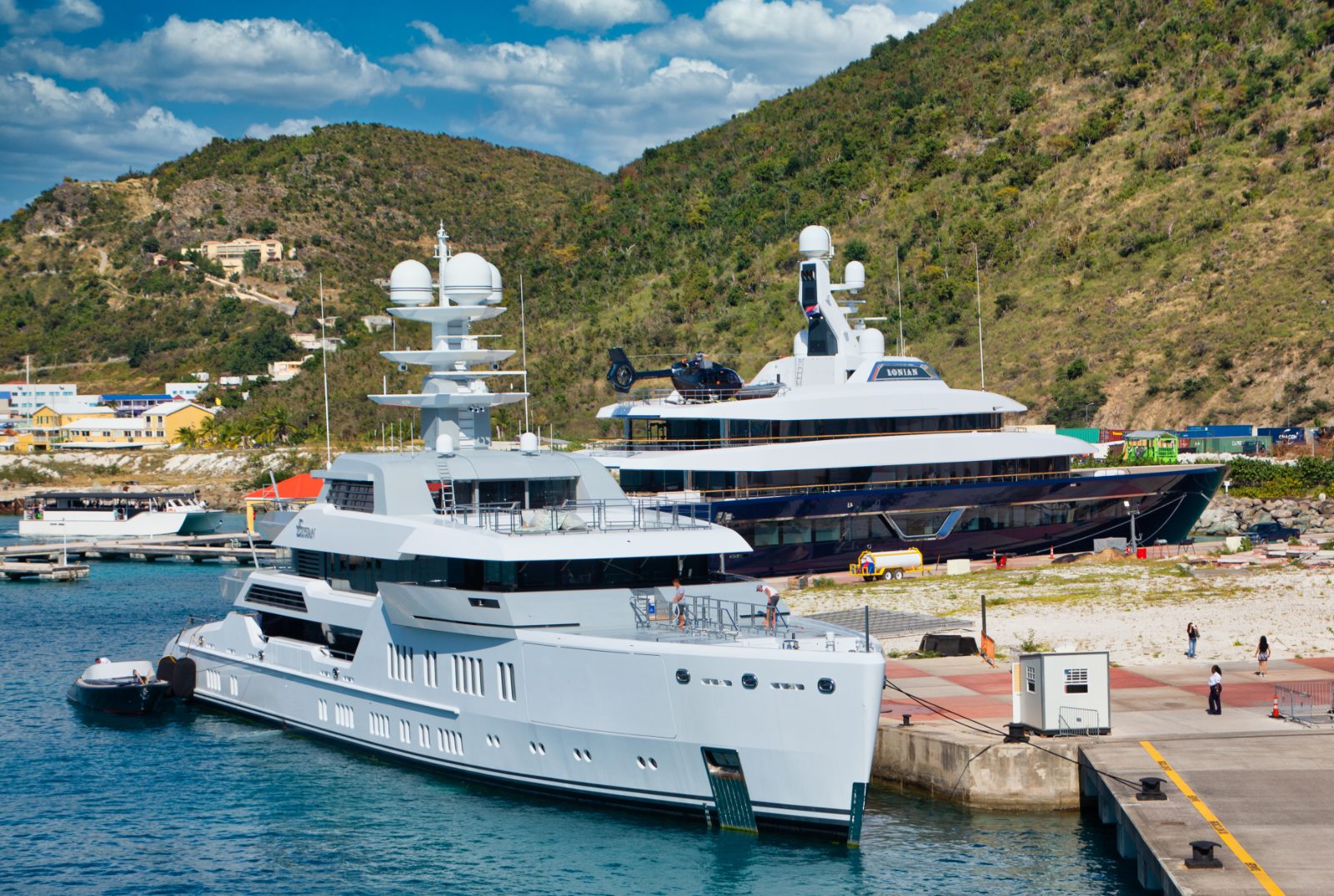
The fleet migrates. The Mediterranean season runs May to late September, with July and August the peak. The Caribbean season runs December to March, peaking over Christmas and New Year. April–May and September–October are shoulder in the Mediterranean, and rates there often sit close to low-season levels with far better availability — discounts of around 20% off peak pricing are common outside high season.
Seven days is generally the minimum charter period a yacht will accept. We have seen ten- and fourteen-night minimums quoted for Christmas and New Year and they are common in practice, but we could not find a published source establishing them as a rule, so we treat them as yacht-by-yacht rather than a convention.
Event weeks
Monaco during the Grand Prix is the clearest illustration of what event scarcity does to a berth. For 2026 the race ran 4–7 June, berth occupancy was fixed at 1 to 8 June, applications closed on 27 February with a €300 non-refundable application fee, and an allocation committee decided who got in — Ports de Monaco states plainly that requests far exceed available places. Around 106 yachts berthed in Port Hercule; roughly 180 more lay at anchor along the Riviera. Reported berthing costs from the port’s own 2026 brochure show a 50–59 metre yacht at about €110,135 for the week, up roughly 47% on 2019.
Cannes during the Film Festival — 12–23 May in 2026 — works the same way, with berths on the Jetée Albert Édouard effectively spoken for nine to twelve months ahead. For both, the practical plan is usually to anchor off and work by tender.
What changed in 2026
The EU Entry/Exit System is fully operational. Since 10 April 2026, entry and exit of non-EU nationals across 25 member states is recorded in a central database rather than by passport stamp. The 90-in-180-day rule is unchanged. For guests the day-to-day experience barely differs; it is a crew and compliance matter.
EU ETS and FuelEU Maritime widened, and most yachts stay outside them. Both apply to ships above 5,000 gross tons, and from January 2026 the ETS added methane and nitrous oxide alongside CO₂. A yacht capped at twelve guests is not a passenger ship and very few reach 5,000 GT, so the charter fleet is largely out of scope — contrary to a good deal of reporting.
Malta’s Commercial Yacht Code 2025 came into force on 1 July 2025, with yachts certified under the 2020 code transitioning at their first renewal survey after 31 December 2025. Malta flags several hundred commercial yachts over 24 metres, so this touches a meaningful slice of the charter fleet.
Frequently asked questions
Why do superyachts only take twelve guests?
Because a ship carrying more than twelve passengers is legally a passenger ship under SOLAS, which triggers a far heavier construction and safety regime. Yachts stop at twelve to stay outside it. Crew do not count as passengers.
Can I charter a yacht for more than twelve guests?
Yes, but only from the small number of yachts built to Part B of the Red Ensign Group Yacht Code, which permits thirteen to thirty-six passengers. They are scarce and priced accordingly. For a party of fourteen to eighteen, two yachts cruising together is usually the better week.
Does the MYBA agreement set the APA at 30%?
No. The MYBA agreement leaves the APA as a blank to be completed, sets no payment percentages, and contains no gratuity clause at all. Twenty-five to thirty-five per cent APA and a five to fifteen per cent tip are market conventions, not contract terms.
What does the superyacht charter fee include?
The yacht and her equipment, her full crew’s wages, uniforms and food, ship’s stores and linen laundry, and insurance. Fuel, all food and beverage for your party, berthing, harbour charges and local taxes come out of the APA. VAT, gratuity and any delivery fee sit outside both.
Why is my chosen yacht unavailable in Greece?
If she is foreign-flagged and over 35 metres, she works Greek waters under an e-Charter Permission capped at 21 charter days a year, extendable by seven. Late in the season, yachts run out of days. We check this before shortlisting.
How far ahead should I book a peak or event week?
For Christmas, New Year and the August Mediterranean peak, as early as you can. For Monaco during the Grand Prix, berth applications closed in late February for a June race — that decision is made the winter before, not the spring of.
Get a shortlist for your dates
Tell us the week, the water and how many are aboard. Your broker replies within one business day with yachts that are genuinely free for those dates, priced with APA and VAT included. No fee to you — the yacht’s owner pays our commission. We’re NDA-friendly and your details go no further.
Sources
Checked September 2026.
- MCA, MSN 1895 — Red Ensign Group Yacht Code, Part A
- Red Ensign Group Yacht Code, Part B — July 2024 edition
- SOLAS, Consolidated Edition — Chapter I, definitions of passenger and passenger ship
- MYBA, The Worldwide Yachting Association — the MYBA Charter Agreement
- EUR-Lex — VAT Directive 2006/112/EC, Article 56, place of short-term hire
- Independent Authority for Public Revenue, Greece — eTEPAI cruising tax
- Ports de Monaco — Grand Prix 2026 berth allocation
- Transport Malta — Commercial Yacht Code 2025
- YPI Crew — crew numbers by yacht size